CRANBROOK Addressing the worker shortage The forestry industry is working to attract potential employees by TANYA LAING MOORE
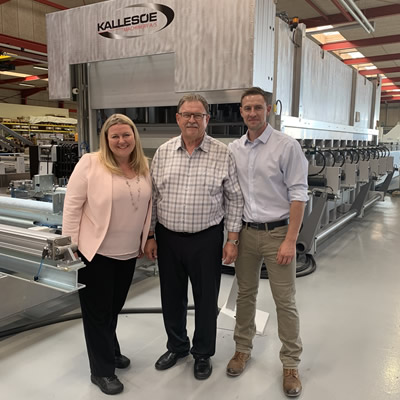
FINDING SOLUTIONS: (L to R) The worker shortage committee includes: Lori Engler, Lloyd Havens and Tracy McGuire from Tembec Inc.; Tony Wideski from Rocky Mountain Forest District; Sterling and Kathy Quennell from S.M. Quennell Trucking; and Marion Eunson from the Ktunaxa Nation Council. —photo by Kris Lindblad
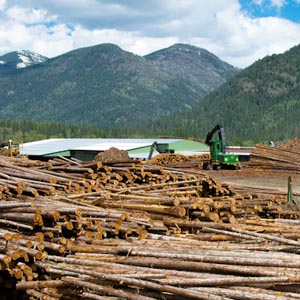
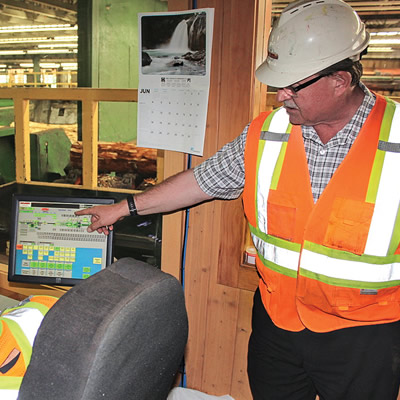
HAVE LUMBER, NEED LABOURERS: The Tembec mill in Elko has been feeling the crunch of the industry-wide worker shortage. —photo by Kris Lindblad
There is a shortage of workers in the forestry sector.
This is the challenge facing the industry right now and the impetus behind the recently formed worker shortage committee that consists of various forest resources management members from both industry and government.
Kootenay Business sat down with four members of the committee—Marion Eunson, manager of Ktunaxa Nation employment services; Tony Wideski, Rocky Mountain district manager for the Ministry of Forests and Range; Tracy McGuire, human resources assistant for Tembec; and Lloyd Havens, general manager for Tembec’s Kootenay Columbia region—as they addressed the worker shortage.
Beginning the process
Havens discussed the worker shortage from Tembec’s perspective.
“We basically saw a need (for workers) from working with our contractors,” said Havens.“ (They) were short in log truck drivers, road construction operators (and) skilled logging equipment operators. We also noticed that our contracting/consulting side for forest planning and professional side in supervising and harvesting operations were having difficulty filling some of the positions that they had. We’ve seen a big change in our demographics as far as the age of our workers. For example, we know of six road construction workers who are over the age of 65. It’s great to have skilled workers of that age, but sooner or later they’ll be ready to retire.”
Havens said that the worker shortage extends to the trades and manufacturing side of the forestry industry, though that shortage is not as drastic as it is in resource management.
A meeting of the minds
Eunson brought forth the First Nations perspective of the worker shortage issue.
“The Ktunaxa Nation—as this is our traditional territory—are very active and have always been very active within the forest industry as forest stewards within the land,” said Eunson. “We realize even communities where the forest industry is still healthy have their challenges. Increasingly, the rural and remote areas where companies operate are losing residents—especially young people—to the cities, and many are venturing into the Alberta oil and gas industry. This migration will mean labour shortages when today’s workforce starts to retire. The workforce shortage is real and growing. Forestry is still widely dismissed as a low-tech, low-skill sector when the opposite is true. More than ever, the industry needs a technology-savvy, skilled workforce.”
Although the demand for workers has increased, there has been a visible decrease in young people seeking training in forestry-related fields. Havens pointed out that BCIT recently discontinued its forestry program because enrolment has dropped off significantly.
“We’d like to turn the tide on that side of things,” said Havens.
Wideski agreed with Havens about the need to bring skilled workers into the field.
“From the Ministry of Forests and Range, one of our (objectives) is to ensure a world-competitive industry,” said Wideski. “A lot of people don’t realize that on an annual basis, the Crown collects about $1 billion from Crown timber, which goes to pay for schools, roads and hospitals. We’re always mindful that in order to have a healthy forest industry, we need to have people entering the job streams. From our perspective, we have a lot of jobs that are outdoor oriented. (Aside from the) high-profile firefighting jobs, we also have environmental monitoring, road building, silviculture, etc.”
Wideski stressed that the industry is facing a retirement wake of between 25 and 40 per cent in the next five years, increasing the crisis the industry will face without an influx of new workers.
Identifying the problem of a worker shortage was the first step in the process; from there, Tembec invited contractors, First Nations groups, training and educational facilities and other forestry-related companies—including Galloway and Canfor—to participate in finding answers.
Implementing plans
One of the key concepts to arise from the collaboration was a career exposition to highlight the forestry industry, both as a means of recruiting new and future employees and to increase awareness of the importance of forestry as a whole. The career expo, which will take place in Cranbrook at the Cranbrook Rec Plex on June 2nd, will showcase the diversity of employment possibilities within the industry. The expo will feature firefighting and heavy equipment demonstrations, logger sports, exhibits from forestry companies and related businesses, a job board highlighting currently recruiting companies, information on the mountain pine beetle as well as guest speakers and door prizes.
McGuire is the administrator for the career expo and hopes the event will help revitalize interest in forestry.
“I have found that, since I’ve begun this project, I’ve become more involved in the worker shortage issue—this is the beginning,” said McGuire. “What are the other things we want to accomplish after the expo? Things like training programs, working with the harvesting contractors and training facilities and bridging that gap, so that we have people coming out who can enter the workforce directly. (We’d also like to see) a centralized place where people can apply for industry jobs within this region. There definitely is a gap of information because of the nature of the business; we contract out a lot of our harvesting—there’s a bit of segregation there. People tend not to talk to one another. But we’re all experiencing the same thing so maybe there’s a way to amalgamate all those needs and create a place for people to go to (for job information).”
Eunson stressed that the career expo is a short-term solution.
“The worker shortage committee has a lot more to do,” she said, “but this will definitely impact the local region.
“The Ktunaxa Nation is very active in strategic planning and encouraging industries to tap more effectively into First Nations communities, many of which have a growing youth population. First Nations communities present an excellent opportunity—a ready supply of local young people who, given the right education and training, could build up the forestry workforce.”
A rewarding field
Havens spoke about the many benefits of working within the various forestry-related fields.
“Our industry—the forest industry—is a sustainable industry,” said Havens. “It’s renewable. There’s always going to be a demand for forest products, whether that’s in lumber, log homes or specialty products.”
A perpetual demand for forest-related products means a perpetual need for skilled workers of all descriptions.
Havens stated that the East Kootenay region has excellent infrastructure and great diversity within the forestry sector, including sawmills, pulp mills, planer mills, log construction and more. There are also vast opportunities for on-the-job training within the field.
“You don’t necessarily have to go to university or a trades school to get a good-paying job working with our contractors in the bush,” said Havens. “They’re paid well, there are benefits to go with that, and it’s enough to raise and sustain a family on.”
Forestry is also a safe industry, said Havens, adding that Tembec was recently SAFE-certified by the BC Forest Safety Council; the expectation is that all Tembec contractors will be SAFE certified within the year. More resource management companies, including Tembec, are aiming for more environmentally friendly practices—Tembec was recently certified by the Forest Stewardship Council.
Key Forestry contacts
Specialty Cut Lumber For Sale! The Tobacco Plains Sawmill caters to hobbyists and others in need of specialty cut sizes of lumber. Most of the mill's lumber is made from pine and fir. The lumber is rough cut but can be planed, if needed. The sawmill is owned and operated by the Tobacco Plains Indian Band, one of seven bands of the Ktunaza Nation, in Grassmere, B.C. Contact the band for lumber prices or for information about the band's other business ventures: the Tobacco Plains Duty Free Shop and Edwards Lake Campground
Tobacco Plains Band Sawmill Grasmere, BC PHONE: (250) 887-3461
WEBSITE: