
If Cranbrook’s mayor and council could be said to have a slogan, it might consist of a single word: “streamline.”
In the past two years, City administration has simplified and clarified the approval processes for development, planning and engineering. It has made the budgeting process more efficient, trimmed back the time spent at council meetings and saved significant amounts of money by tendering projects early in the year, when contractors are hungry.
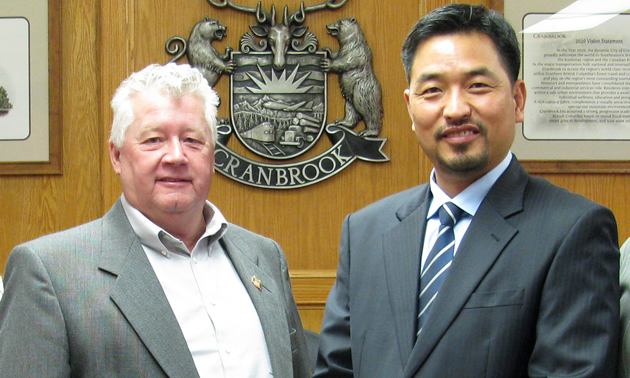
Word is getting out about Cranbrook’s new, pared-down development approval process, and in the first two weeks of September three developers contacted the City of Cranbrook to ask about land base availability. David Kim, Cranbrook’s new CAO (who Cranbrook’s mayor, Lee Pratt, calls a rock star in terms of his contacts and influence), is still busy restructuring the City departments, but once that’s done he’ll join in spreading the word among his contacts.
In addition to the extensive desk-based work required to streamline those processes, City administration has overseen infrastructure improvements and road work, installation of LED streetlights and improvements in energy efficiency in several City properties. The City partnered with the Cranbrook Chamber of Commerce and local hoteliers to establish Tourism Cranbrook; it opened a new off-leash dog park; and it completed a number of much-appreciated improvements to Cranbrook’s leisure services, among other initiatives.
“We have accomplished a lot in the first half of this term,” said Pratt. “And at the same time we’ve kept our tax increases to 2.58 per cent and 2.26 per cent—that’s less than the previous administration had budgeted for one year.”
Reaching beyond the region
During the Union of B.C. Municipalities convention in Victoria in late September 2016, Mayor Pratt met with representatives from the Vancouver Port Authority, CP Rail and a number of stakeholders to discuss the possibility of establishing an intermodal freight depot near Cranbrook. The idea was well received. Ongoing discussions have been planned and information is being gathered from all stakeholders who would use such a facility.
“We’re doing a preliminary study on how it could look,” said Pratt. “We’re working with the minister of highways and the vehicle inspection services. In October we surveyed the trucks that go through here. We asked them where they originated, what they’re hauling, where they’re going, how often they come through here and what (additional) services they’d like to see here. We think we need another major truck stop here.”
Pratt also met with staff from the office of the Minister of International Trade and the Ministry of Jobs, Tourism & Skills Training & Responsible for Labour, regarding the relocation of existing companies and attraction of new industries to the Cranbrook area. Those offices have been provided with information they can give to potential investors.
For the home team
To make City services more easily available to Cranbrook residents, Pratt and his council are looking at installing a one-number call system to handle issues and complaints. The new system would replace the current departmental call system, and Pratt explained how it would work:
“Say your issue is a pothole on your street. You phone our number to report it, and you get to talk to a real person who will ask you a few questions and then connect you to the public works guy who can tell you when the problem will be fixed. You get your answer right away—no waiting for someone to return your call or your email.
“We’re getting rid of some red tape and bureaucracy and getting things done quickly. It’s a common sense approach, and it gives us better control of our infrastructure, better repair time, reduced risk and a happier customer.”
Looking ahead, Pratt is excited about the City’s direction. “We have a culture that is ready for industry,” he said. “We’re not Nelson and we’re not Vancouver—we’re a service centre, and we can become an even bigger one. We have gas, power and land, all a lot cheaper than on the Lower Mainland. We have a skilled workforce, good air travel connections, schools and medical care—we have everything that investors are looking for.”