

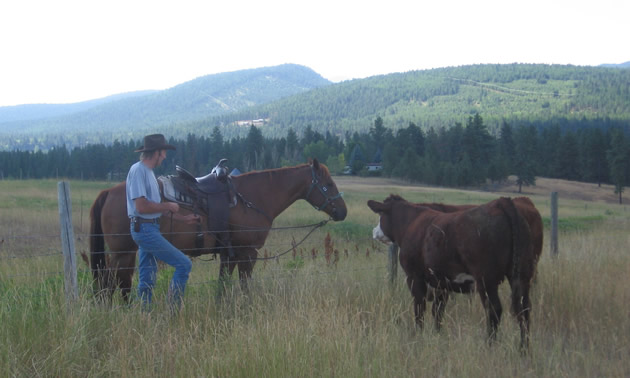
2 of 4Tim Ross and his horse, Spur, work at moving the grass-fed steers to new pasture. — Photo courtesy Tim Ross
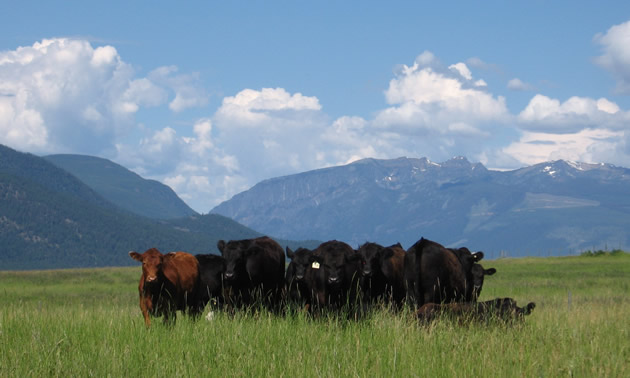
3 of 4The steers are pastured on the grasslands of St. Mary's Prairie, near Cranbrook, B.C. — Photo courtesy Tim Ross
4 of 4Kootenay All Natural Beef Company is located on the St. Mary's prairie, near Cranbrook, B.C. — Marie Milner photo
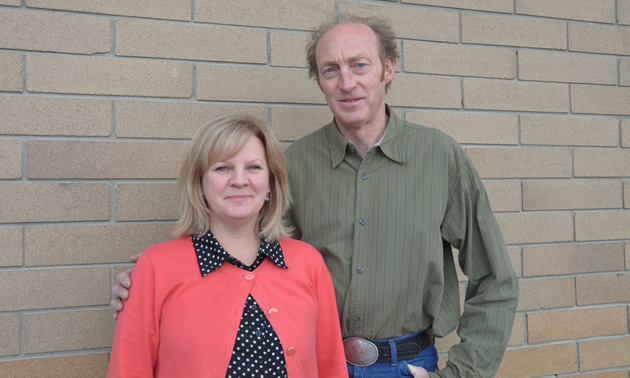
‹ › …A few kilometres north of Cranbrook, B.C., lies an area of fertile grassland known as St. Mary’s Prairie. Tim Ross and Tracey Whiting own a grass farm here, and for almost 20 years they have kept horses, raised a few steers and grown a large vegetable garden. Both work full time.
Ross is a self-employed agricultural consultant who does contract work for government and business. Some years ago his research revealed to him the benefits of grass-fed beef, so he and Whiting decided to raise their own meat animals.
Starting with one
“We had more grass than we needed for our horses, so we bought some steers and butchered one for our own use,” Whiting said. “The following year we butchered two, and we shared it with some friends. The next year we had enough people calling us that we thought, ‘There’s a business here.’ ”
That was the beginning of Kootenay All Natural Beef Company. Whiting explained that they lease an adjoining ranch from a friend and mentor who is in sync with their farming practices and has become a business partner. Every spring, Ross checks the fences—fixing what the local elk have damaged—and sets up irrigation pipes.
Clean and ethical
Ross said that the action doesn’t really get started until the yearling steers arrive.
“We buy steers in the spring,” he said. “We have a couple of sources that know we want cattle that have never had hormones or antibiotics and can finish on grass. We give them fresh water, salt and minerals, and that’s it other than grass.
“We believe in treating our animals ethically. We practice low-stress livestock handling, so when the steers arrive they are kept in a small pasture and accustomed to being around people, horses and dogs. Then, about every two weeks we move them to fresh pasture. When the time comes, it’s a short trailer ride to a local government-approved abattoir.”
“A lot of our clients share our concerns,” said Whiting. “They want low stress for the animals, they want good nutritional food that is locally sourced—they’re into the slow-food movement.”
Receiving and giving back
Ross further explained their philosophy and methods.
“Besides making a healthy product, we use what the land gives us and in turn work to improve the land,” he said. “We graze the pastures in rotation so that they aren’t overused. That allows for rapid plant regrowth and allows the natural fertilizer the cattle leave behind to replenish the soil nutrients. There are no commercial inputs of any kind. These animals are raised on grass from start to finish.”
Whiting said that their lives are busy and satisfying, and that Ross somehow also finds time to play in a band.
Ross laughed. “Some of the songs we write are about ranching and steers, though, so it all works together.”