
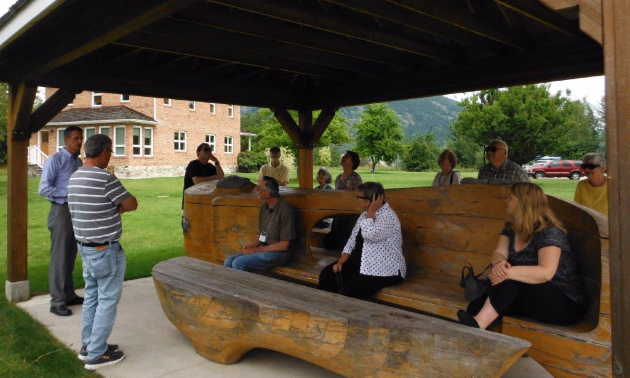
When you're married, you get to attend reunions, homecomings and such with your significant other whether you want to or not. But I have to say the pleasure was all mine when I attended the City of Castlegar's homecoming weekend this past summer (my husband is the Castlegar boy). It was a superbly organized event that included a tour of Selkirk College, among many other activities.
The year 2016 marks the 70th anniversary of incorporation of Castlegar as a village, the 50th anniversary of the community's incorporation as a town and the 50th anniversary of Selkirk College.
Selkirk College, by the way, appears on Kootenay Business magazine's Top 50 list of Kootenay companies.
Castlegar's pride in its history was evident throughout the weekend, and so was the college's pride in its new science labs and the ongoing work that the Mir Centre for Peace, located on the college campus, does in the areas of peace and justice.
Selkirk College's main campus is in Castlegar; there are satellite campuses or learning centres in Nelson, Grand Forks, Trail, Kaslo and Nakusp, so the West Kootenay is well served by the 50-year-old educational institution.
So, what’s new at Selkirk College?
Attracting rural doctors
Well, the college’s rural pre-medicine (RPM) program has received an endorsement from the School of Medicine at the University of Calgary (U of C). This stamp of approval comes from ongoing efforts to develop a major inter-institutional collaboration, according to a college press release.
“This is excellent news for our students and for the continued development of the RPM program,” said RPM co-ordinator Elizabeth Lund. “It also puts a public face on what the medical schools have been communicating all along—they support us, believe in our program and want to work together.”
Selkirk College launched its rural pre-medicine advanced diploma and associate degree program as a proactive solution to a rural doctor shortage. Offered at the Castlegar campus, the three-year program offers students wanting to pursue careers in medicine the opportunity to acquire all of the pre-requisites and training needed to apply to medicine and other health-care professions.
Banking on the knowledge that students from a non-urban background are more likely to choose a career in rural medicine, the comprehensive program supports rural and aboriginal students by offering a rigorous academic schedule and an opportunity to interact and learn from health professionals in a rural setting.
“Our program was set up as a pilot project and is the first of its kind in Canada,” said Lund. “We hope to provide a model for other rural colleges in B.C. and Canada who want to offer a similar program.”
Accepting its first class of 17 students in the autumn of 2014, this year those students will graduate and the U of C validation comes at a perfect time. More Selkirk College students will now be eligible to apply to the U of C where typically medical schools have raised eligibility criteria for out-of-province residents.
“The announcement from U of C means that instead of needing a GPA of 3.8 out of 4.0 and an MCAT score of 128 (87th percentile) before being eligible to apply, a student will be eligible to apply using the same criteria as that used for Alberta residents, a GPA of 3.2 and no minimum MCAT score,” Lund said.
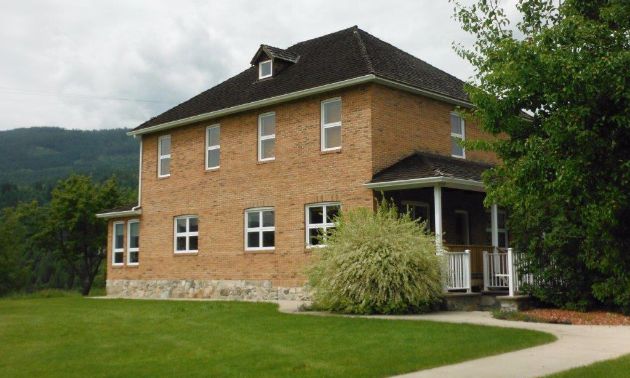
The Mir Centre for Peace, formerly a communal Doukhobor dwelling, hosts an international conference in late September. — Gerry Warner photo
Promoting peace and justice
In other Selkirk College news, the Mir Centre for Peace, housed in a restored communal Doukhobor dwelling on the Castlegar campus, is hosting an International Peace and Justice Studies Association (PJSA) conference September 22 to 24, which will include Friday night “peace cafés” in downtown Nelson. The conference itself takes place at the college’s Tenth Street campus in Nelson.
Keynote speakers at the conference are Wab Kinew and Sandra Moran. Kinew wears many hats, as author, musician, politician, broadcaster and university administrator. He is originally from the Onigaming First Nation in northwestern Ontario. Moran is a social activist, performance artist and congresswoman from Guatemala.
The peace cafés are described in a college press release as a positive way to dialogue on issues that matter, led by people in the know. Or, put another way, people are invited to spend a relaxed evening engaged in some serious conversation.
Up for discussion at the café events will be such topics as racism and anti-Semitism, political violence, restorative justice, climate action and issues faced by indigenous and gay communities. Discussions will be moderated by experienced leaders.
The peace cafés are “an opportunity to get together with others to discuss these important issues with people who know what they are talking about,” said Mir Centre chair Randy Janzen. “People will be hearing some music and having some beverages and food. This will lend itself to creating an environment where people are feeling social and engaged.”
RESOURCES:
www.selkirk.ca