


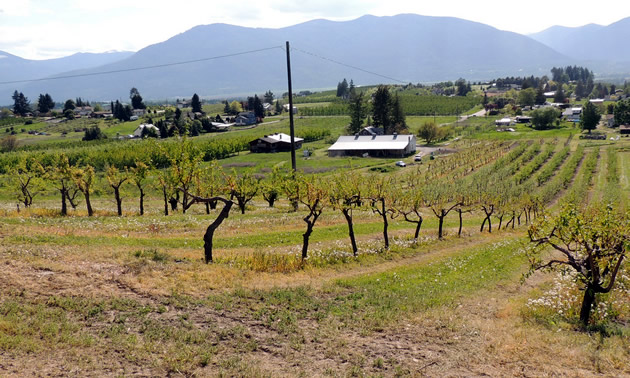
2 of 2JRD Farms in Erickson has a vineyard and a variety of fruit trees. — Kristen Mitchell photo
‹ › …Tucked against a sunny hillside in the Creston Valley is a rambling old orchard full of apples, pears, peaches, plums, apricots and mint-green bee boxes. At the top of the hill are Pinot Noir grapes, a new addition. After owning JRD Farms since 2006, David Mutch began creating value-added products in 2013 together with his partner, Amy White, under the company name William Tell. The first products to go to market were Sparkling Old-Fashioned pear and apple ciders.
“We didn’t have any idea how it would be accepted or what people would say,” said Mutch. “We started out with 1,000 (litres) of apple and 1,000 of pear and thought, OK, we’ll see how long this lasts. They lasted about six weeks. Then the panic mode struck and we realized we had to make more.”
The sparkling non-alcoholic pear and apple ciders have remained popular ever since. Mutch and White said the cider they made from last year’s fruit will sell out by the end of the season as they gear up for an even busier year. The company has apple and pear cider vinegar ready for sale in the summer, as well as a pending application for a licence to begin production of hard cider, which they hope to offer in the fall of 2014. Eventually they will also produce a local wine from their grapes, which are grown in the highest-elevation vineyard in B.C.
Creating a local value-added product
William Tell’s products are created right in the Creston Valley from local fruit. Apples, once the fruit du jour in the Creston Valley, have given way to rows of cherries. When William Tell begins producing hard cider it will be the easternmost cider company in B.C.
“I think people like to see that there’s something new being done with all the products that are here,” said Mutch. “I don’t know why no one else thought of it in the last 50 years that we’ve been growing apples (in Creston).”
Mutch said that one of the biggest challenges for new agribusinesses such as William Tell is financing. The Creston company has started with minimal capital and free of loans. This has meant a slower start; everything is bottled by hand. However, the gradual approach also makes for a sustainable business model. Over the last year, William Tell has been building a local customer base and brand recognition.
Establishing a brand
With experience working at Mission Hill Family Estate, a winery in the Okanagan, Mutch understands the value of attractive packaging and branding. He wanted to avoid a cheesy company name and logo. The tree graphic used on William Tell products was drawn by an acquaintance. Then, while shopping, White noticed a black label and thought it looked sharp. The final design work was also done locally and the William Tell logo, a white tree on a black background, was born.
“I like the freedom and being able to be creative in different ways,” said Mutch. “I’m not super artistic, but I have an idea of how things should go together and what people will accept in the marketplace.”
So far, William Tell is off to a promising start. The Sparkling Old-Fashioned ciders are available throughout the West Kootenay as well as in Canmore and at the Kimberley City Bakery. Mutch and White have no plans to expand past the Kootenays in the near future, as long as there’s local demand. They have noticed a growing appreciation for local, diverse agricultural products.
“We produce amazing stuff here—such a variety,” said Mutch. “We’ve got the milk and the cheese and the wineries down the road. All sorts of cool things are happening here, and other areas are starting to realize it . . . Everyone sort of drove through Creston before and now there’s reasons to stop and see what’s going on.”